Context
Small game teams and solo developers can reach dozens of generative models — image, 3D, texture, audio, LLM — but every one has its own API, its own billing and its own failure modes, and none of them knows what a game asset needs to be. Getting from a concept sketch to a rigged, animated, PBR-textured model in Unity meant stitching five or six services together by hand, every time.
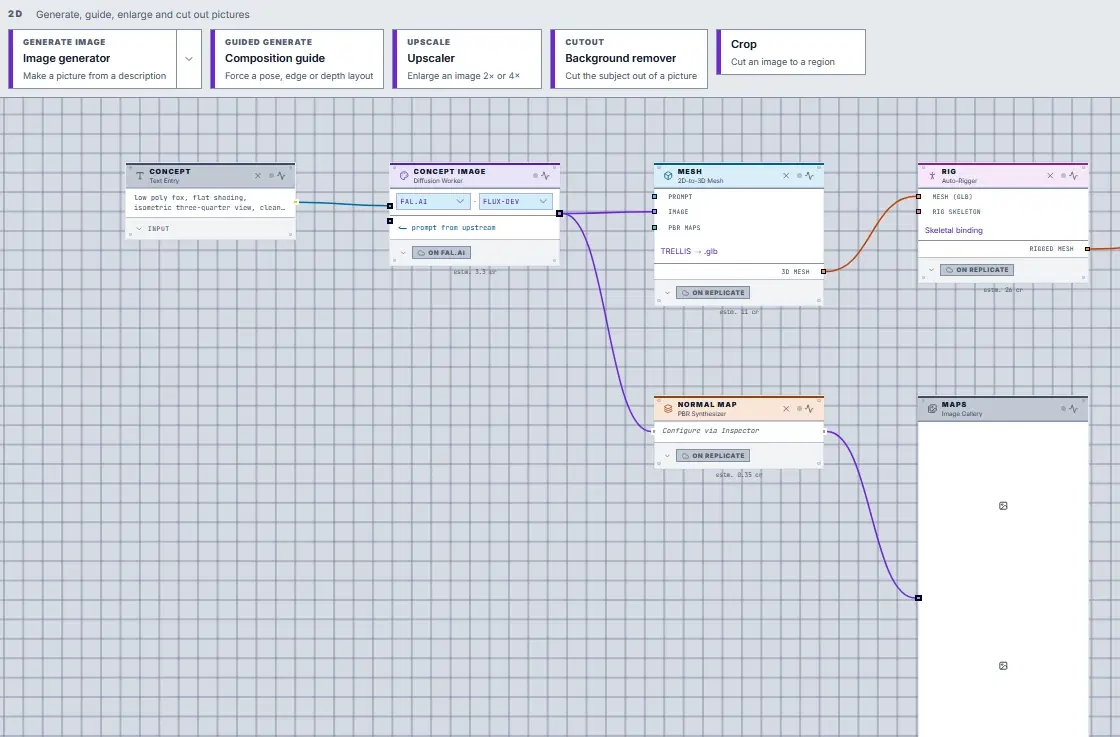
Sushibelt is the platform I founded and built solo to close that gap: a visual, node-based orchestrator where a workflow is a graph, each node runs on whichever provider suits it, and the output lands where the game is.
The Challenge
Three things had to be true at once, and each is a full product on its own. The orchestration had to be real — long-running, multi-step, partially failing runs across many providers, not a single prompt-and-response. The money had to be honest — every step costs real inference, so charging, reservations, refunds and vendor payouts had to be exact to the cent. And it had to be a product people could be invited into, with a library, sharing, a marketplace and an assistant, rather than an internal tool.
Doing that alone set the fourth constraint.
Approach
I built the whole stack: Next.js 15 on AWS Amplify SSR for the application, Supabase for data, auth, storage and Realtime, a scheduler Lambda for the long-running steps, and Stripe for money. One person cannot afford a service mesh, so every piece was chosen for how little of it there is to operate.
Agentic development is what made the scope viable. The work runs as spec → plan → build under a written framework of agent roles, playbooks and cross-domain contracts, with review passes that measure the product against real data rather than the plan. Several of the most important defects — a storage quota that failed open past a thousand assets, an ownership check that trusted a public-read RLS policy — were found by those reviews, not by users.
Architecture
A workflow is a DAG. The dispatcher walks it, routes each node to a provider by node type with fallbacks, reserves credits at dispatch, and leaves long-running steps to a scheduler Lambda that polls them on a one-minute tick, retries, and re-advances the run. Every provider sits behind one adapter, so the 2D → 3D → rig → animate → PBR → Unity lane is a single graph a user can run, version and share.
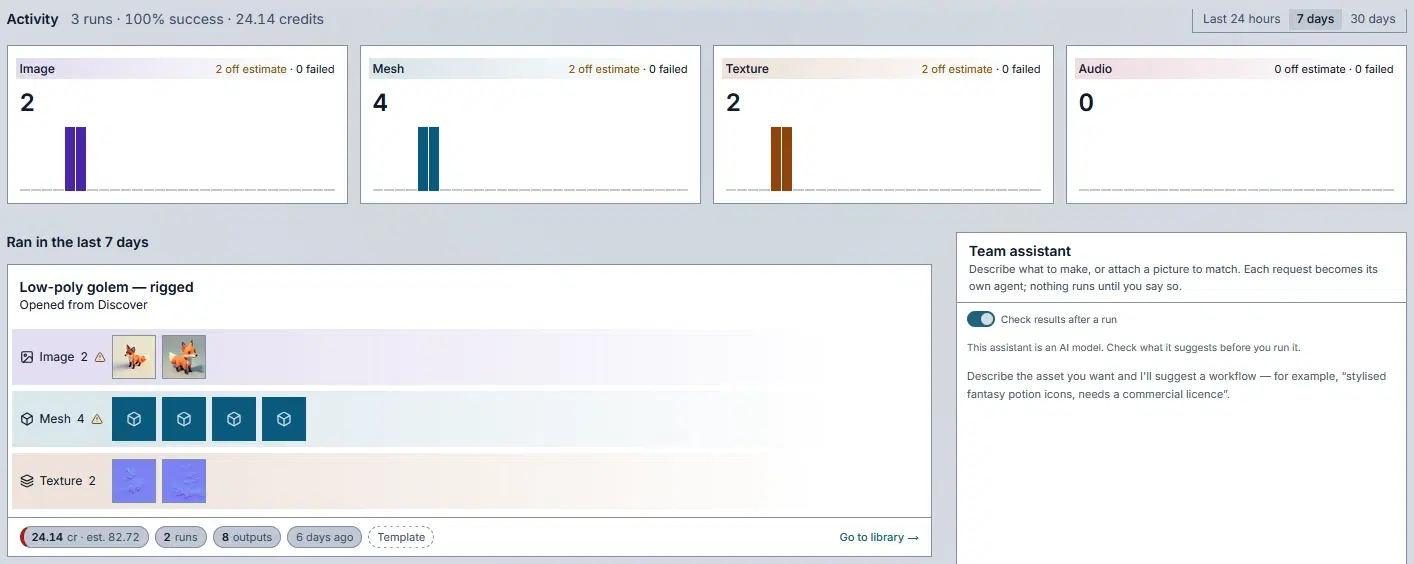
Money runs through one ledger. Every charge, refund, subscription refill and bonus is a row; reservations are taken at dispatch and reconciled on completion; payouts to marketplace vendors are built on Stripe Connect. Storage is metered against a per-team quota summed in the database. Multi-tenancy is enforced with Row-Level Security, with explicit ownership checks on any table that is public-read.
The AI layer is built on top as five dependent features: retrieval with pgvector over the library and model catalogue, assistant memory the user can read and edit, a typed tool registry with an audit table, a goal-driven orchestration loop under a credit budget, and MCP exposure for headless use.
Outcome & Impact
In production since June 2026 in its own AWS account, with an invite-only beta since late August, a vendor marketplace, and the complete game-asset pipeline. It is also my reference for what a modern AI product costs to build and run when one person builds all of it.